The Faculty of Global Studies celebrates its 12th anniversary this year. Unique to Sophia University, the faculty was established to develop “Global Studies” by integrating International Relations and Area studies—two fields with a long history and strong tradition in Sophia’s research and education—as its two main pillars.
The curriculum—designed to enable students to engage simultaneously with a global perspective, through International Relations that examine worldwide dynamics, and a local perspective, through Area Studies that attend closely to the lived realities of specific regions—is unique among universities. With this, FGS has taken a step toward a new development in Sophia University’s global education.
By the way, what comes to your mind when you hear the word “global”?
Compared to ten years ago, after experiencing a pandemic, conversations on social media and online meetings have become commonplace. Learning opportunities are also increasingly sought online, and it feels as though the process of becoming borderless has accelerated even further. Meanwhile, conflicts and confrontations over territory and resources are being manipulated by fake news and left unresolved. Issues such as refugees, human rights violations, poverty, and inequality, as well as global environmental problems, are all shared challenges across the world, yet each also carries distinct regional characteristics. In each case, diverse and intricately intertwined causes make the search for solutions far from simple.
To address these various issues, it is necessary not only to understand the history and society of specific regions but also to situate them within the context of global society and examine them through theoretical frameworks. Various approaches from history, sociology, politics, anthropology, and education are possible here, and an interdisciplinary perspective is also required. A key feature of FGS is the ability to selectively study a wide range of languages, including 13 Asian and African languages, as tools for understanding specific regions. Rather than blindly believing information encountered online, we provide a framework that allows students to see and verify the realities of regions and societies with their own eyes, leading to new discoveries.
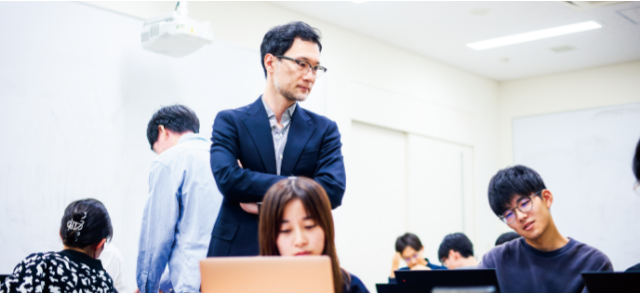
While FGS offers such diverse approaches and subjects, it is not a place for passive learning. We expect students to maintain an attitude of constantly reflecting on what they want to achieve, explore ways to realize those goals, as well as consciously choose and take on new challenges. Our 26 full-time faculty members, specializing in International Relations and Area Studies, are here to support students in this process.
The objective of the FGS is to cultivate global human resources. However, this does not only mean preparing students to work for international organizations or pursue careers overseas. We aspire to nurture individuals who can understand social diversity and observe current trends with both breadth and depth as well as a composed perspective, and who can excel in professional fields—whether domestically or internationally—backed by their own deep learning.